I. A Historical Echo: The 1929 Crash and the 2026 AI Wave
Professor James K. Galbraith of the University of Texas argues that—based on his theory regarding the true root causes of the 1929 Wall Street Crash and the ensuing Great Depression—the 2026 AI tech wave is stepping on the same historical rhymes.
First, he lists the complex and conflicting theories the economic community has proposed over the past century to explain these events. Examples include Hyman Minsky’s “Financial Instability Hypothesis" (capitalism is inherently fragile); William K. Black’s “Controlled Fraud" (deregulation allowing insider profit); John Maynard Keynes, who blamed the collapse of businessmen’s profit expectations driven by “animal spirits"; Milton Friedman and Anna Schwartz, who blamed the Fed for failing to stop the money supply contraction; Ben Bernanke and Christina Romer, emphasizing the spike in market uncertainty; or Larry Summers, who vaguely attributed the crisis to a “failure of exchange mechanisms."
Galbraith, however, argues that the real trigger for the 1929 crash was a disruptive energy technology revolution. In the early 20th century, the physical economy and financial assets of the US were heavily dependent on coal, steam engines, steel, and a massive cross-state railroad network. However, in late October 1929, Texas, Oklahoma, and California successively announced the discovery of massive oil reserves. Media reports detailed how Standard Oil was slashing prices due to overproduction and cutting inventory.
Why did the discovery of massive, cheap, high-quality energy not bring the expected economic prosperity, but unexpectedly trigger billions in financial losses, evolving into historical “Black Thursday" and “Black Tuesday"? The answer lies in the fact that financial market pricing reflects the future profit expectations of the “existing industrial system." At the time, banks held massive assets in coal and railroad bonds, while corporate profits relied on the rail transport network and coal power systems. The oil discoveries meant that these heavy-asset investments faced unannounced obsolescence. Expected profits hit zero overnight. Companies stopped capital investment, prices for agricultural and industrial goods collapsed, banks couldn’t recover loans (encountering bank runs), and the real economy suffered a chain reaction collapse—the Great Depression began.
Galbraith points out that if today’s AI technology represents an industrial-revolution-level advancement, it could very well repeat the depression of 1929.
To simplify this with my own understanding:
From an economic perspective, competition forces many industries impacted by AI to lower their profit expectations, thereby reducing asset prices. If these asset prices (whether tangible property, land, factories, machinery, or intangible property such as intellectual property, corporate bonds, and stocks) are interwoven into a complex financial market via collateral and borrowing, it forces a downward revision of even more complex financial derivatives based on them (such as credit swaps). This asset price correction strengthens negative macro expectations and alters economic behavior, creating a negative feedback loop deflation similar to 1929 or 2008.
On the other hand, can the actual income growth generated by new AI technology catch up with the hyped revenue bubbles? If releasing data convinces more people that growth speed cannot keep pace, combined with a worsening objective interest rate environment, the AI bubble will burst. Since mid-year, borrowing rates and the difficulty of borrowing for AI-related companies—especially in the “neo-cloud" sector—have risen sharply. Viewing this as a risk premium indicates that more and more in the market are losing confidence.
II. The Conspiracy of China-US AI Competition
I believe this conspiracy theory has low credibility, but it is interesting.
According to clearer data over recent months, we can see that the actual income growth from the AI tech revolution is far below the “castles in the air" drawn by its promoters.
The conspiracy theory suggests this is why the Chinese government has not truly expended “all resources" on the “US-China AI competition." Instead, China is applying and developing AI tech mainly based on its own domestic industrial environment and needs.
In the AI competition, China maintains a pace of “just about catching up to the US" to tempt and frighten US politicians, and provide industry justifications, to deploy vast amounts of US national resources into developing LLMs—which actually offer low returns.
In short, China is tempting the US to fall into the “Star Wars" trap that the Soviet Union fell into decades ago.
The above are two considerations regarding AI for everyone’s reference.
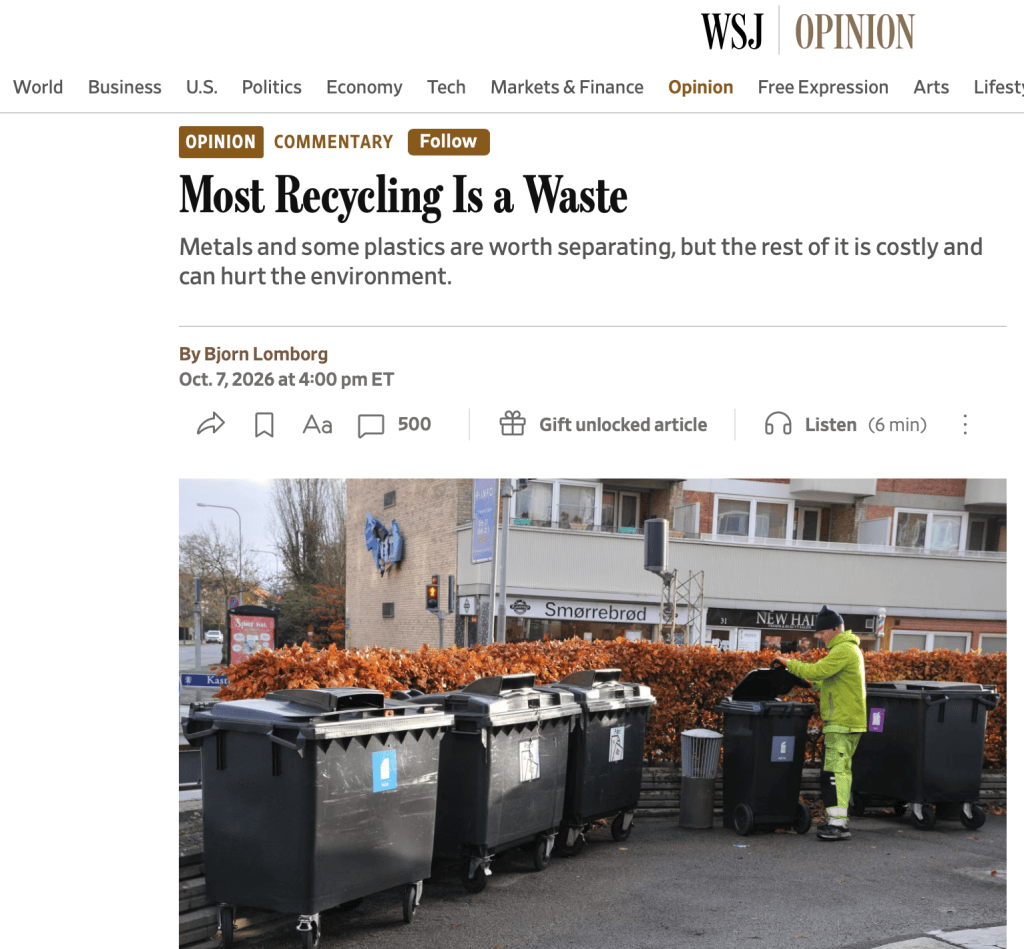
比約恩‧隆伯格(Bjorn Lomborg),這篇在華爾街日報的投書「Most Recycling Is a Wast」其實只是很單純地點出經濟學上機會成本的概念在政府主導的環保活動中常常備忽略。作者是丹麥政策研究者,現任哥本哈根共識中心(Copenhagen Consensus)總裁,並擔任史丹佛大學胡佛研究所(Hoover Institution)訪問研究員。
斯泰恩‧范紐沃伯格還指出,如果目前預計中的 AI 基礎建設全部完成,其相對於美國經濟的投資規模,可能超過美國歷史上的運河、鐵路、電氣化、高速公路和電信投資浪潮。真正危險之處還包括融資方式正在改變:原本由大型企業直接放在資產負債表上的投資,愈來愈多轉向合資企業、私人信貸、證券化、特殊目的公司、租賃承諾與貸款擔保等較不透明的表外結構。
這些融資最終仍依賴 AI 公司未來的現金流與資料中心抵押品價值,但兩者都高度不確定:AI 需求究竟有多大仍不清楚,科技可能快速淘汰現有設備,工程能否準時取得電力與硬體也是問題,而且整個產業高度依賴少數大型資料中心租戶的信用。范紐沃伯格並沒有斷言 AI 已形成類似過去信貸泡沫的系統性金融風險,而是提出較謹慎的警告:表外融資可能讓彼此高度相關的風險在景氣反轉以前難以被看見,等問題真正出現時,金融機構才發現大家其實押在相同的假設上。
儘管心懷恐懼,梅里爾始終未曾遵從FBI的信函要求,而是決定在ACLU(後續還有耶魯大學媒體自由與資訊取用診所〔Yale Media Freedom and Information Access Clinic〕)的無償協助下,於法庭上挑戰這項命令的合憲性。這場法律戰持續了11年,徹底佔據了他的人生。梅里爾與律師團主張,這項國家安全信函構成違憲搜查,並侵犯了他的言論自由權——他們最終獲勝。然而國會僅修正了相關的NSL條款,其禁言令規定卻依舊維持不變,這場法律戰因此又拖延了數年之久。即便該國家安全信函最終被全面撤銷,梅里爾仍持續爭取公開談論其存在的權利。「那是個許多處境相似的人,幾乎都選擇在自己辦公桌下噤聲蜷縮的時代,但他認為自己身為公民,有義務公開發聲,抗議這種他認為已逾越界線的監控權力,」代表梅里爾打了這場法庭戰前六年的賈法爾說道,「他的勇氣讓我印象深刻。」